The first question we ask about any staircase is not about the rider — it is about the stairs. Whether your staircase is straight or has any turn in it decides which kind of stairlift you need, how it is built, and how quickly it can be installed. Here is the plain version of how to tell, and what each path involves.
How do I know which type I need?
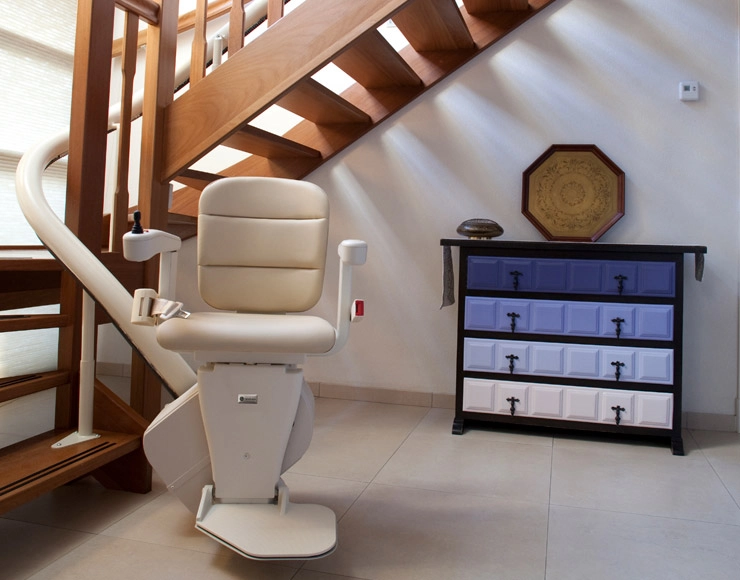
Stand at the bottom of your stairs and look up. If the staircase runs in one uninterrupted flight — no landing, no turn, no curve — you need a straight stairlift. If there is anything else — a landing halfway, an L-turn, a U-shape, a curved sweep, even a small winder at the top — you need a curved stairlift, because the rail must follow every change in direction as one continuous piece. A landing technically allows a third option (two straight lifts, one per flight, transferring at the landing), but for most people one continuous curved rail is the safer, better experience.
What makes a straight stairlift simpler?
Straight rails are standard components cut to your staircase length, which keeps everything fast:
- The Savaria K2 installs in a few hours on either side of the stairs, carries up to 350 lb, and folds to under 11 inches from the wall. Savaria’s rack-and-pinion drive gives it a smooth, positive climb.
- The Handicare 1100 takes a different engineering approach — four motors driving on a fully sealed rail with no exposed gear rack to catch dust or fingers. It carries 310 lb standard (287 lb on inclines steeper than 46 degrees) and folds to about 12 5/8 inches.
- The rail fastens to the stair treads, not the wall — so plaster, trim and railings on the wall side are untouched.
Why are curved stairlifts custom-built?
Because no two turned staircases are the same. Curved rails are manufactured to your exact staircase: Savaria custom-fabricates the twin rails of the Handicare 4000 using its photo-measuring system, and produces custom rails in as little as two weeks. Two carried models cover the style spectrum:
- The Handicare 4000 rides a twin-rail system — the choice for steep runs and tight turns — carries up to 350 lb with the heavy-duty rail, and can park around a 90 or 180 degree turn at the top or bottom, out of the doorway.
- The Handicare FreeCurve rides a single tube rail custom-curved from photo measurements — a slimmer, more furniture-like look — carries 275 lb, handles inclines from 0 to 61 degrees, and offers the Active seat option that raises and rotates as you travel.
How do the timelines compare?
Straight: often installed within days of your assessment, with the installation itself taking a few hours. Curved: add the rail manufacturing window — production in as little as two weeks from measurement, then an installation visit. Either way the process starts the same: a free in-home assessment where we measure the staircase, check the electrical outlet, and show you seat options and controls.
Does funding apply to stairlifts?
Ontario’s Assistive Devices Program does not fund stairlifts — they appear on its published exclusion list. Depending on your situation, Veterans Affairs Canada (whose policy names stair glide installations for eligible veterans), WSIB for workplace-injury claims, March of Dimes Canada’s Home and Vehicle Modification Program (custom stairlifts are among its funded request types, to a $15,000 means-tested maximum), and the federal Home Accessibility Tax Credit can all be routes. The funding directory covers each one.
Quick answers
My stairs have one landing — is that curved?
Which side of the staircase does the rail go on?
Will the stairlift block the stairs for everyone else?
Can I try one before deciding?
Not sure what your staircase counts as? Send a photo, or better, book the free assessment — measuring it properly takes us twenty minutes and costs you nothing.