
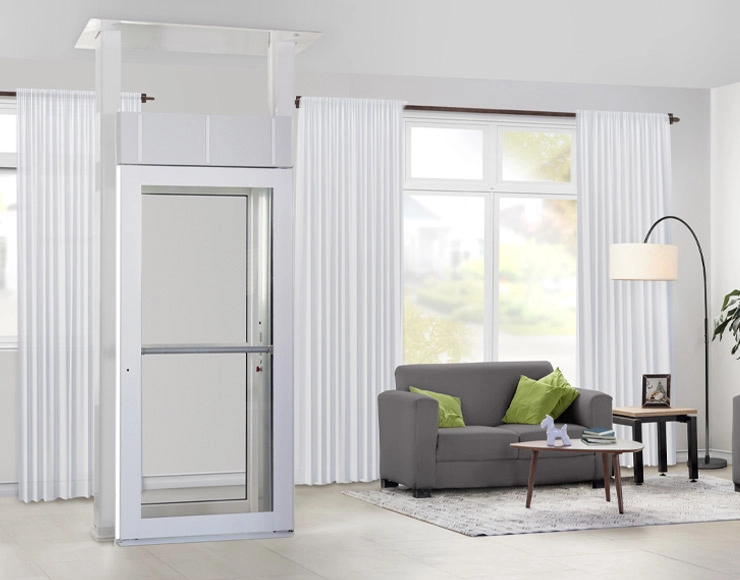
If stairs have become the hard part of living in your house, you have two very different ways to solve it: a stairlift that carries you along the staircase, or a home lift that moves you between floors through the floor itself. We install and service both across Collingwood, Blue Mountains and the surrounding counties, and the honest answer is that neither is better — they solve different problems. Here is how we help customers decide.
What is the difference between a stairlift and a home lift?
A stairlift is a motorized seat that travels on a rail mounted to your staircase. You sit, ride to the top or bottom, and the seat folds away when not in use. A home lift (also called a through-floor lift or residential elevator alternative) is a cab that travels vertically between two floors through an opening in the floor — no staircase involved at all.
When is a stairlift the right answer?
A stairlift is usually the right call when you can transfer safely on and off a seat, and your goal is simply to stop climbing. Points in its favour:
- It works with the house you have. A straight stairlift like the Savaria K2 installs in a few hours on either side of the stairs, and folds to under 11 inches from the wall so family can use the staircase normally. The Handicare 1100 folds to about 12 5/8 inches.
- Curved staircases are covered too. Rails for the Handicare 4000 and FreeCurve are custom-fabricated to your exact staircase from photo measurements.
- Weight capacities are generous — up to 350 lb on the K2 and on the 4000 with its heavy-duty rail.
When does a home lift make more sense?
A home lift earns its place when a seat on the stairs is not enough — or will not be enough for long:
- You use a wheelchair or expect to. A stairlift still requires transferring to the seat and having a chair on each floor. A through-floor lift carries you seated in your own chair. The Savaria Telecab 17 carries up to 845 lb — rider, wheelchair and a companion.
- Your staircase is not a good candidate — too narrow, unusual construction, or shared with other household traffic all day.
- You want the whole-house solution. The Savaria Luma is fully self-supporting — no shaft, no support wall — and needs roughly a 38 by 47 inch patch of floor, so it fits in a corner of the living room or beside a stair. The Telecab anchors to a reinforced support wall and offers two cab sizes.
What does installation involve for each?
A straight stairlift is the lightest touch: rail fastened to the stair treads (not the wall), installed in a few hours. Curved stairlifts add a manufacturing step, since the rail is built for your staircase — Savaria produces custom curved rails in as little as two weeks from measurement. A home lift is a small construction project by comparison: a floor opening is cut between levels, and for the Telecab a support wall is reinforced. Every detail is confirmed at a free in-home assessment before anything is ordered, and our own team installs and services all of it afterward.
Can funding help with either one?
This surprises many families: Ontario’s Assistive Devices Program does not fund stairlifts or lifting devices — its official exclusion list names stair lifts, chair lifts and lifting devices, and home renovations. But other routes exist: Veterans Affairs Canada policy explicitly contemplates stair glide installations for eligible veterans, March of Dimes Canada’s Home and Vehicle Modification Program funds custom stairlifts and platform lifts for Ontario residents in financial need (to a $15,000 maximum, means-tested, and not guaranteed), and the federal Home Accessibility Tax Credit lets a qualifying household claim up to $20,000 per year of eligible renovation expenses. Our funding directory walks through every Ontario option.
Quick answers
Can I stay in my wheelchair on a stairlift?
How much space does a home lift need?
Which one is faster to get?
What happens to the stairlift when guests use the stairs?
The genuinely honest way to decide is to stand in your hallway with someone who installs both. Book a free in-home assessment — we measure, talk through how your needs may change, and give you a straight recommendation either way.